Sunday, September 13, 2026

The Controversy Over AI Art and DeviantArt


Self-Portrait: "Yearning" created in Adobe Photoshop and Photo Lab.
Mixed Media: Digital Painting + AI tools used. 

The Controversy Over AI Art and DeviantArt

When 2020 hit the world, I spiraled into a deep depression. Not only were people dying from COVID, but we were also dealing with shutdowns, isolation, and uncertainty. At the same time, my mom was in the process of dying from breast cancer.

I lost my drive and passion to draw and paint.

I shut down my Facebook and Instagram art accounts, as well as my art website. I kept my art blog, Zazzle, and Etsy stores, but socially, I withdrew. I stopped interacting with most of my traditional art and photography friends, except for maybe one or two.

After my mom passed away in January 2021, I slowly began dabbling in art again. I experimented with acrylics and decoupage and created gifts for family and friends. I even tried wood burning, although the smoke aggravated my asthma.

Then, in May 2023, Adobe introduced Generative Fill, powered by Adobe Firefly, in the Photoshop beta.

Something happened that I wasn’t expecting.

I became inspired again.

When AI Opened a Door to Creativity

Generative AI gave me and other artists another way to manipulate images and explore ideas through prompts. Suddenly, things I had imagined in my mind—but couldn’t quite figure out how to draw or paint—could potentially be brought to life.

I was astounded.

I could describe something I had envisioned in my mind, sometimes in great detail, and within seconds I could see a visual interpretation of that idea.

But almost immediately, I found myself asking a question that many artists have asked:

If I use AI to create a work of art, is it really my artwork—or is it the AI’s artwork?

I don’t pretend to have a definitive answer to that question.

For me, I decided that if I use AI to create or help create a piece of artwork, I am comfortable acknowledging the AI tools I used. I look at it much like a collaboration with another creative tool—or, in some cases, another artist.

But there is something important that I think sometimes gets overlooked.

The AI doesn’t decide what I want to create. I do.

I am the one who has the idea.

I am the one who develops the concept.

I am the one who writes the prompt.

I am the one who decides what works and what doesn’t.

And I am often the one who takes the resulting image and continues working on it.

For example, Adobe’s AI doesn’t always understand human anatomy correctly. Hands, feet, eyes, noses, mouths, and other body parts can come out completely wrong. I frequently have to digitally paint and correct those areas myself.

The finished piece can involve considerably more than simply typing a sentence and clicking a button.

Where My Images Come From Matters to Me

I also believe strongly in respecting other artists and photographers.

When I create my artwork, I use my own stock photographs, stock photographs that I have legally purchased, or photographs that I have permission to use. I may also use my own drawings as references for composition or execution.

If there is a particular artistic style that inspires me, I may describe characteristics of that style in a prompt or use a style reference.

But there is an important line I will not cross:

I would never intentionally copy another artist’s artwork.

That is something I feel very strongly about.

I was heavily involved in copyright protection and protecting artists’ work when I participated in art groups on Yahoo, Facebook, Sketchfest, and DeviantArt. We watched out for one another. If we discovered someone’s artwork had been stolen and was being sold on eBay, Etsy, DeviantArt, or another website, we reported it.

I still believe in doing that today.

In fact, I get excited when I see the work of old art friends being sold legally on products. It is wonderful to see how their artwork has developed and how successful they have become over the years.

Interestingly, all of those friends have eventually left DeviantArt.

Returning to DeviantArt

DeviantArt and Facebook were where I spent much of my time with fellow artists after the Yahoo groups began shutting down.

Over the years, there has been a great deal of criticism and controversy surrounding DeviantArt. Some traditional artists feel that AI has taken over the platform. Others are frustrated by the amount of sexually explicit content and what they perceive as low-quality or repetitive artwork.

I understand those frustrations.

But after returning to DeviantArt myself, I discovered something I didn’t expect.

I found my inspiration again.

Not only through AI, but through DeviantArt itself.

I’ve been making new art friends, and the talent I am seeing is incredible.

There are artists using AI as part of their creative process and then digitally painting, editing, and refining their creations. There are traditional digital artists, photographers, illustrators, painters, and artists working in combinations of all these mediums.

The diversity is amazing.

Yes, DeviantArt has always had artwork that I personally have no interest in viewing. There is plenty of content I simply scroll past. But that doesn’t mean I believe I should decide whether someone else’s creation qualifies as art.

If an artist genuinely considers what they have created to be art, who am I to tell them otherwise?

I may not like it.

I may not understand it.

I may not even want to look at it.

But I can still respect their right to create it.

At the same time, I completely understand why some traditional artists have left DeviantArt. Their concerns about AI, copyright, artistic identity, and the changing nature of the platform are legitimate.

I am not writing this to tell them they are wrong.

I am simply sharing my own experience.

AI brought me back to creating art when I had lost my passion for it.

And DeviantArt helped inspire me again by allowing me to see what other artists are creating.

For that, I am grateful.

So, Is AI Art Really Art?

The great AI art debate will undoubtedly continue.

People will continue arguing about whether computer-generated imagery can be considered authentic art. There will continue to be concerns about copyright infringement, the use of artists’ work in training datasets, artistic ownership, and whether AI could eventually displace human artists.

These are important conversations, and I don’t believe they should simply be dismissed.

Many artists argue that AI has no soul, no personal experiences, no consciousness, and no genuine emotions. Therefore, they believe anything produced by AI is merely a statistical simulation rather than true art.

But I think there is another question worth asking:

What about the person behind the prompt?

A prompt can be incredibly detailed. It can contain imagination, emotion, memories, symbolism, personal experiences, and passion.

The person writing that prompt is bringing something to the creative process.

And today’s AI tools allow artists to go even further. In Photoshop, for example, an artist can use their own drawing as a composition reference and provide a separate image as a style reference. The technology can become another tool in the artist’s creative toolbox.

Does that make the computer the artist?

Or is the computer the medium?

That is a question each of us will have to answer for ourselves.

Remember Colored Pencils?

This debate actually reminds me of something from my own artistic journey.

For many years, colored pencil artwork wasn’t taken seriously by the traditional art world. Colored pencils were often viewed as a child’s medium rather than a legitimate fine-art medium.

Colored pencil artists were laughed at and mocked.

But I didn’t care.

I loved colored pencils.

It was my passion, and I continued creating with them regardless of what other people thought.

Eventually, galleries and the art world began recognizing colored pencil as a legitimate fine-art medium.

Today, colored pencil is an established and respected artistic medium, and there is an incredible community of professional colored-pencil artists producing breathtaking work.

So perhaps AI art is going through its own version of that struggle.

Maybe today’s arguments about whether AI-assisted artwork is “real art” will look very different years from now.

I don’t know.

But I do know this:

Art has always evolved.

New mediums, new technologies, and new methods of creating have often been questioned when they first appeared.

Photography was once criticized as not being “real art.”

Digital art was once dismissed by some traditional artists.

Colored pencil was once considered a child’s medium.

And now we are standing at the beginning of another technological shift.

Perhaps AI will eventually become accepted as another artistic medium—not because the machine itself has a soul, but because there is a human being behind the imagination, the choices, the direction, and the desire to create.

For me, that’s what matters.

I lost my passion for creating art.

Then something unexpected helped me find it again.

AI didn’t replace my imagination. It gave my imagination another way to speak.

And DeviantArt reminded me that there are still countless artists out there creating, experimenting, learning, and inspiring one another.

So instead of immediately dismissing something because it is different, I encourage you to explore it.

Go look at the digital artists on DeviantArt.

Look beyond the controversy.

Look beyond the arguments.

Look at the creativity.

You may be surprised by what you find.

And you might even find yourself inspired.

Note: My blog post was edited and parts revised by Chatgpt.

Keep on Creating!

Carol Moore


Sunday, March 29, 2026

Dabbling with AI and Digital Painting in Adobe Photoshop

For quite some time now, I have been dabbling with Digital painting and AI in Adobe Photoshop. I know many artists are opposed to AI. I totally understand why, but when I create my images, I use my own stock, free stock, or paid stock. Often, more than not, AI does not render body proportions right and other elements within a piece, so nine out of ten times, I have to go in and repaint a piece or create areas within the piece that reflect my vision more concisely. What I love about AI is that I can usually capture what I am envisioning in my head, which I cannot always do with pencil and paper, or paint and canvas.

The piece below was inspired by Avril Lavigne's song "Head Above the Water". The stock used for reference was from nastiaosipovastock and pixabay. It was created in Adobe Photoshop using mixed media - digital painting and AI. 

Like artwork, music speaks to each person differently. Verses in songs or art pieces capture one's attention and speak to one’s soul, inspiring and provoking a roller coaster of emotions. 

“Head Above the Water" spoke to me in a way that I had to share what my mind was envisioning every time I heard this song. As we journey through this life, we experience different struggles. Some of us feel like those struggles are drowning us, bogging us down, taking us down, down, down into the dark depths. The only way we can keep our heads above the water is to reach out for the One who can truly help us through those struggles, and keep our heads above the water, and that is God.

You can check out more of my digital/AI works here 


"Head Above Water"
Mixed Media: Digital Painting and AI


Happy Creating Everyone!
Carol Moore

Monday, July 31, 2023

Jackson Bottom Wetlands


This past Saturday, we journeyed to Jackson Bottom Wetlands Preserve in Hillsboro, Oregon. The 635 acre wetlands is named after the Hyer Jackson family, who came to Oregon in 1854. 

Back in 2020, during the COVID peak, we visited this preserve's 4.5 miles of trails and observed many wildflowers, native plants, wildlife, and birds. On this trip, we saw several native plant and flower species, herons, killdeer, swallows, deer, bunnies, and squirrels.

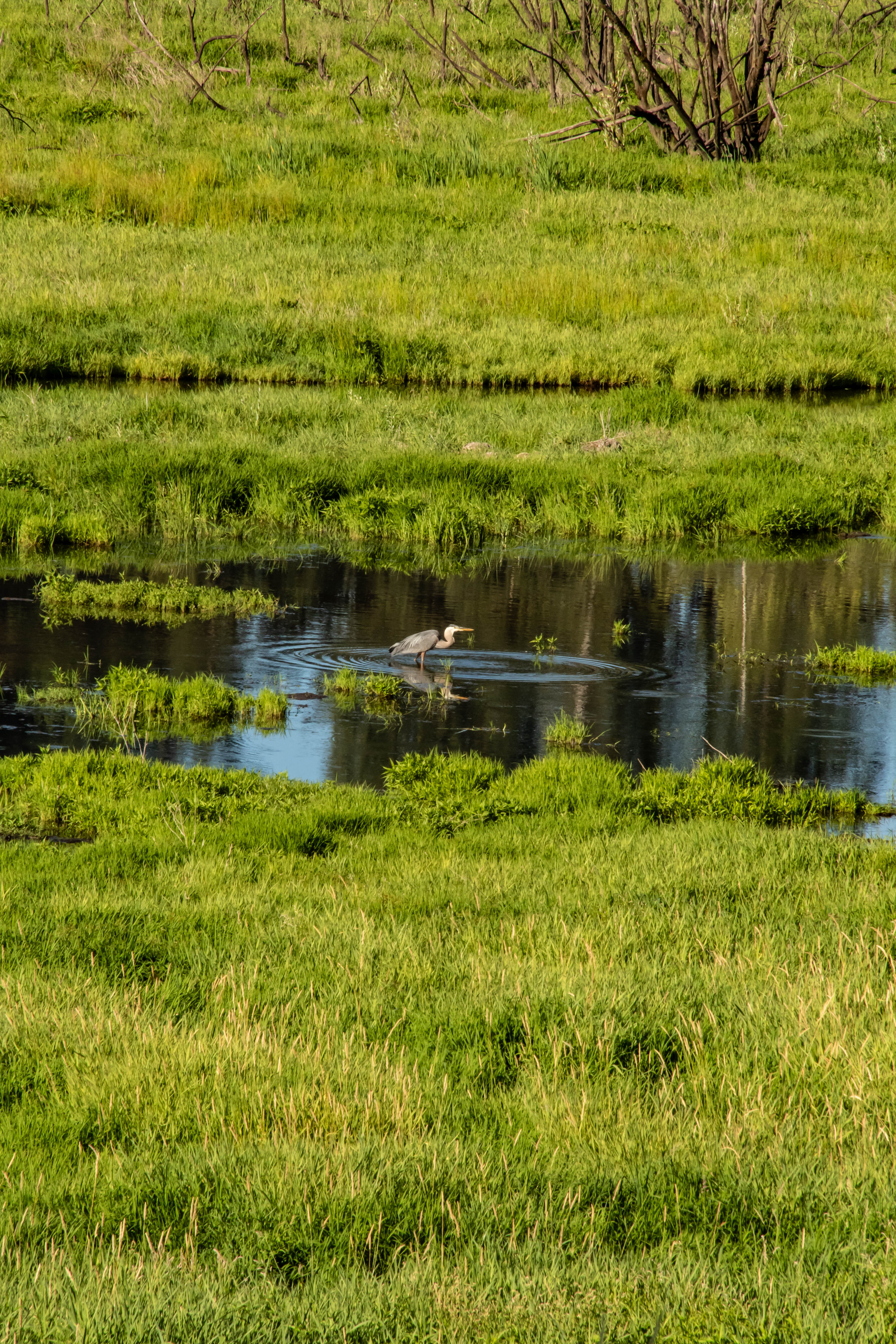
Jackson Bottom is a great place for bird watchers. There are over 200 species of birds on the preserve. Some species of birds can only be observed during certain times of the year, depending on their migration periods. We saw numerous Great Blue Herons on our most recent trip. Most were in flight. They are an elegant bird, and they have a very distinct call. They stalk their prey by waiting patiently and motionless then they strike their prey quickly. 

Great Blue Heron


Abundant wildlife can be observed within the preserve. From Black-tailed Deer to Bobcats to Fox Squirrels. 
We were blessed to observe this Black-tailed Deer meandering through the fields along Pintail Pond. Black-tailed Deer are part of the mule deer family and are most active in the early morning or evening. They bed down during the heat of the day.

Black-tailed Deer

There are over 300 native plant species and wildflowers within the preserve. We were blessed to see a few of the wildflowers still blooming, such as madia, moth mullein, yarrow, nightshade, tarweed, clarkia, hardhack, chickory, and aster.


This will not be our last journey to Jackson Bottom Wetlands. The migration of several species of birds in the fall is on our watch list at this amazing preserve. 

Until Next Time
Happy Creating and Hiking!
Have a blessed week!
God Bless,


Saturday, July 15, 2023

Killin Wetlands Nature Park and the Quilt Barn Trails in Oregon


Killin Wetlands Nature Park

We ventured north today up along Hwy 47 towards Banks, Oregon. Our first stop was the Killin Wetlands Nature Park Trail. The park was formerly a dairy farm built in 1941. It is over 370 acres of peat soil wetlands and scrub-shrub marshes. It is a great trail for bird watching, wildlife viewing, observing wildflowers and other native plant species. The trail is short. It is only 0.7-mile long. The trail does not get close to the water, so make sure that you bring a long binoculars or a spotting scope to view the birdlife and wildlife in the area. If you plan on taking pictures of any of the wildlife or birds on the trail, you will need a good zoom lens for your camera at least 500mm. My 300mm didn't even get close enough to capture the four bald eagles and the great blue heron we were so blessed to see on this outing. The area is known for the sightings of American Bittern, Greater Yellowlegs, Mallards, Double-Crested Cormorants, and many other species of birds and elk.

Killin Wetlands


Adult Bald Eagle

Juvenile Bald Eagle

Great Blue Heron

Honey Bee

Curly Dock

Chamomile

Queen Anne's Lace

Queen Anne's Lace

Pine Cone

Wild Oat

Wild Sweet Pea


Quilt Barn Trails of Oregon


The restored barn at the beginning of the Killin Wetlands Nature Park trailhead features one of the giant quilt blocks of one of Oregon's Quilt Barn Trail. The Oregon Quilt Barn Trails are four trails located throughout Tualatin Valley in Washington County. All of the wooden quilt blocks are located on the sides of barns scattered throughout Banks, Forest Grove, Gaston, Hillsboro, Cornelius, North Plains, Helvetia, Aloha, Scholls, Sherwood, and Tualatin. The wooden quilt blocks are hand-painted in traditional quilt patterns that hold some significance to the farm owner or history of Oregon, the history of the surrounding area, or the history of the farm. We were able to view a few of the quilt blocks on the west part of the Quilt Barn Trail, but we plan on checking out more of the quilt blocks in the near future. It was a great time and a way to learn more about the farms in the Tualatin Valley.

The Killin Wetlands Kistner Barn Quilt Block's theme is “Doves in the Window.” It represents birds, as Killin Wetlands is a bird sanctuary.

 
Doves in the Window


The L Bar T Bison Ranch Quilt Block's theme is "Eight-pointed star." It represents the pattern made by women crossing the Oregon Trail.


The Walta Farm Quilt Block's theme is "Corn and Beans." It represents the sweet corn and green beans grown in rotation on the farm.

Corn and Beans


The Rohrer Farm Quilt Block's theme is "Chasing Geese." This design was chosen by the Rohrer's due to the many geese in the area, and also to honor the six tribes of Native Americans that made their home very near to the site.

Chasing Geese

Until Next Time
Happy Creating and Hiking!
Have a blessed weekend!
God Bless,


Sunday, July 2, 2023

Hiking Willamette Mission State Park and New Store Gift Items


Exploring Oregon this past weekend, we traveled to the Willamette Mission State Park, which is a 1300-acre park located on the south side of the Willamette River. A five dollar day use fee will get you into the park to enjoy it's many trails and waterscapes. The park includes two lakes - Mission and Goose. Goose Lake's trail appeared too muddy to travel upon and we didn't want to get our shoes muddy, but we could hear ducks and herons. Mission Lake has two boat docks, one that is ADA-friendly.

Mission Lake

There are fields, orchards, woodlands, wetlands, hiking trails, horseback riding trails, bike trails, campsites, and day-use areas. There are over 15 miles of trails for one to explore and enjoy.  

Map of the park

Along Mission Lake Trail is a viewing platform overlooking Mission Lake and the ghost frame structure of the old Willamette Mission site. There are signs about the mission itself to learn about the history of the old Methodist mission.

Mission Ghost Frame


The park is home to the largest Black Cottonwood tree in North America. The Willamette Mission Cottonwood stands 155 feet tall and is over 215 years old.


The park is home to many native plants, wildflowers, variety of bird species, and wildlife located throughout the area.  

Chickory


Daisy


Oregon Grape


Wild Teasel


Until Next Time
Happy Creating and Hiking!
Have a blessed 4th of July!

God Bless,


Saturday, June 3, 2023

Blue River Reservoir, Aufderheide Scenic Byway, and Cougar Reservoir in Oregon


Charred Tree on the Aufderheide Scenic Byway 


Memorial Day Weekend

This past Memorial weekend, we traveled south to the McKenzie River Corridor area near Blue River, Oregon. Blue River is east of Eugene and Springfield. In 2020 the town of Blue River was decimated by the Holiday Farm Fire/Rainbow Fire as it tore through the McKenzie River Corridor. It was one of the largest wildfires in Oregon history. My husband was one of the volunteer fire fighters who helped fight that fire. It burned and destroyed more than 173,000 acres and over 500 homes and businesses along the McKenzie River Corridor. You can check out this link to see what devastation the fire did to the town of Blue River and the nearby businesses. Destination Oregon: Blue River, one year after the devastating fires 

However, life is slowly returning amidst the charred ruins, and people have rebuilt homes or are in the process of rebuilding their homes. Though the forest throughout this whole region may be littered with charred tree remains, life is blooming amidst the devastation.

Aufderheide Scenic Byway 

The Aufderheide Scenic Byway is part of the 220-mile West Cascades Scenic Byway. Along the Aufderheide Scenic Byway (Forest Service Road 19) is Cougar Reservoir. The byway was closed further up past the French Pete campground due to winter weather.


Blue River Reservoir

Amidst the charred remains of the Holiday Farm fire is the Blue River Reservoir. The reservoir is located 45 miles east of Eugene and 1 mile north of Oregon Route 126 in the Willamette National Forest. Turning up the exit to Blue River Reservoir, one can see the fire damage where trees and homes once stood, but God's beautiful creation was abounding throughout the area.

spotted sandpiper


H.J. Andrews Experimental Forest

H.J. Andrews Experimental Forest is located north of Blue River Reservoir and was established in 1948 by the U.S. Forest Service. The research includes watershed processes, forest ecology, old-growth Douglas-fir forests, and plantation. There were many wildflowers in bloom on our travels there, and snow drifts still covered some of the upper roads melting off into the streams and small waterfalls.


Until Next Time
Happy Creating and Hiking!

God Bless,